




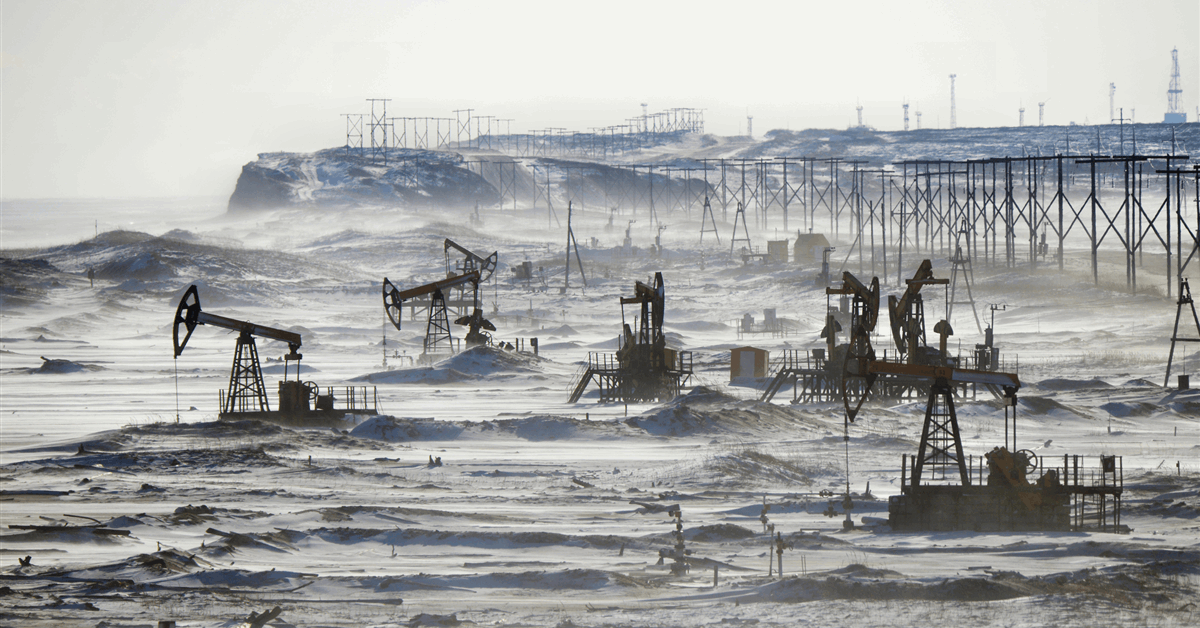


Russia’s oil producers lowered the tempo of drilling in 2025 to the bottom stage in three years, dimming the outlook for output development this yr as Western sanctions and a robust ruble undercut income.
Rigs drilled about 29,140 kilometers of manufacturing wells within the nation final yr, down 3.4 % from 2024, in keeping with trade knowledge seen by Bloomberg Information. After reaching file charges within the first months of 2025, exercise began to sluggish in June and slumped about 16 % in December from a yr earlier, the info present.
The slowdown comes as Russian producers are below strain from decrease world oil costs, deeper reductions on their barrels resulting from tighter Western sanctions and a stronger ruble that made exports much less worthwhile. In the meantime, the Group of the Petroleum Exporting Nations and its allies are reviewing how a lot its members are able to producing years forward, in an effort to align output quotas extra carefully with members’ precise talents.
- Advertisement -

Manufacturing in Russia, a de-facto chief of OPEC+ together with Saudi Arabia, has already fallen for 2 consecutive months amid export constraints, and decrease drilling may add additional strain because the alliance weighs its subsequent steps in provide coverage.
“Russian manufacturing is kind of just like the US shale, with output development and decline wanting like an echo of drilling quantity a number of months prior,” stated Sergey Vakulenko, who spent a decade as an government at a Russian oil producer and is now a scholar on the Carnegie Endowment for Worldwide Peace.
Russia’s Vitality Ministry did not instantly reply to Bloomberg request for a remark.
A decline in drilling charges within the second half of the yr is “a rational response of corporations to a collapse in profitability,” stated Gennadii Masakov, former director of the analysis and insights heart at Yakov & Companions and at present an impartial power professional. “Corporations have switched to money saving mode.”
The value of Urals, Russia’s predominant oil-export mix, shrank to $39.18 a barrel in December for tax functions, a 42 % drop from January. After the US blacklisted high producers Rosneft PJSC and Lukoil PJSC, the low cost on Urals to the Brent benchmark widened to about $27 a barrel on the level of export in December – greater than double from the beginning of 2025 – as consumers sought a much bigger monetary incentives to proceed purchases.
On the similar time, the ruble appreciated by virtually 1 / 4 towards the US greenback as Russia’s key rate of interest remained close to a file excessive.
“All these results scale back the ruble-based internet current worth of a potential properly, making the businesses drill much less,” Vakulenko stated.
What’s Subsequent?
Often it takes a number of months from drilling a properly to beginning pumping oil from it, so the latest slowdown is but to be felt. The drop within the nation’s crude manufacturing in December and January was precipitated principally by US sanctions and President Donald Trump’s strain on India to halt purchases of Russian crude as a part of a marketing campaign to finish the battle in Ukraine that is set to enter its fifth yr, analysts say.
Because it takes extra time to seek out consumers for Urals, the quantity of Russian crude held on tankers elevated to about 140 million barrels, in contrast with about 100 million in early October. Ukraine’s repeated assaults on Russian oil fields within the Caspian Sea in December and January additionally contributed to the drop in output.
“The true impact of the drop in drilling hasn’t but turn into evident and shall be seen in manufacturing within the second or third quarters of 2026,” Masakov stated.
With many fields in pure decline, Russia must drill 26,000 to 29,000 kilometers of wells yearly to take care of day by day crude output at about 9.2 million to 9.4 million barrels, in keeping with Masakov’s estimates. “Any additional decline beneath this stage will inevitably result in a decline in manufacturing,” he added.
In January, Russia’s crude-only output averaged 9.246 million barrels a day, or 328,000 barrels beneath the nation’s quota for the month inside the OPEC+ settlement. If Russia’s manufacturing continues to fall, the nation dangers dropping world market share to OPEC+ allies. Some members of the alliance see scope to renew provide will increase in April after the group agreed to maintain output regular within the first quarter.
This yr, Russia’s crude-only manufacturing will decline barely, however greater output of a lightweight oil known as condensate will offset that, bringing the full determine to 2024 ranges, when output was 516 million tons, in keeping with estimates from Moscow-based Kasatkin Consulting. That is equal to 10.36 million barrels a day primarily based on a 7.33 barrel-per-ton conversion fee, and compares with 10.28 million barrels a day final yr.
Russia is able to producing 10.5 million to 11 million barrels a day of crude and condensate, and to take care of that stage for a decade or extra, in keeping with Ronald Smith from Rising Markets Oil & Fuel Consulting Companions LLC.
“In idea, Russia’s potential to extend output could be very excessive, however the whole lot is determined by the financial system, OPEC+ agreements, in addition to home constraints – the central financial institution’s key fee, personnel, applied sciences and operational effectivity – and exterior restrictions on advertising and marketing and delivering the nation’s crude to shoppers,” Dmitry Kasatkin, a managing accomplice at Kasatkin Consulting, stated. “Modifications in any of those components will alter the precise manufacturing potential.”

