



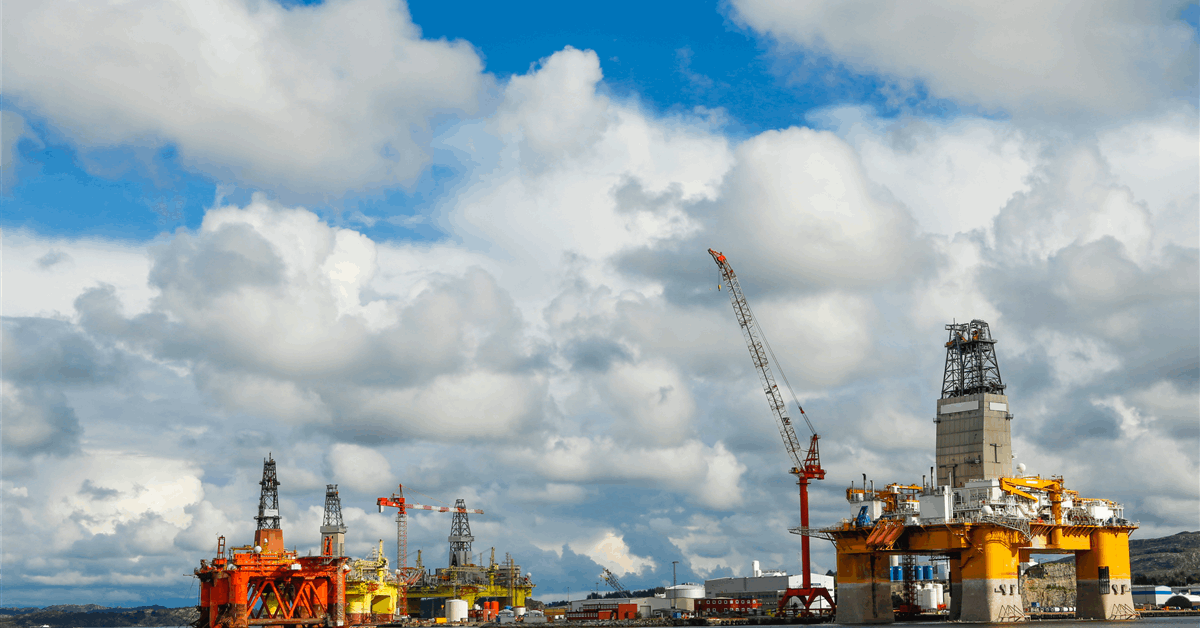
Two appraisal wells drilled by Equinor ASA within the North Sea about 20 kilometers (12.43 miles) east of the Troll A platform have proven an appropriate reservoir for carbon dioxide (CO2) storage.
Wells 32/4-4 and 32/7-1, drilled within the Alphas and Gamma areas respectively, make up a possible injection web site for the “Smeaheia” undertaking. They’re the primary to be drilled underneath exploration license EXL002, awarded June 2022, in keeping with the Norwegian Offshore Directorate.
They’re additionally the second and third wells drilled to analyze the potential for business CO2 storage in Norwegian waters, it mentioned. The primary, nicely 32/4-3 S, was additionally drilled by Equinor in 2019.
- Advertisement -

Nicely 32/4-4 aimed to analyze whether or not Decrease and Center Jurassic reservoir rocks within the Alpha space, the place earlier drilling encountered dry exploration wells, may retailer CO2. It was drilled to a vertical depth of 1,879 meters (6,164.7 ft) beneath sea degree. The water depth was 315 meters.
Nicely 32/7-1 focused Decrease and Center Jurassic reservoir rocks within the Gamma construction. It was drilled to a vertical depth of two,036 meters beneath sea degree. The water depth was 300 meters.
“Formation strain information for each wells point out that the rocks within the Cook dinner and Johansen formations are considerably depleted, whereas the depletion will increase in direction of the Sognefjord Formation, the place it’s biggest”, the Directorate mentioned.
“Intensive volumes of information have been acquired and samples have been taken from the reservoirs and cap rocks within the two wells. 4 injection exams had been additionally carried out in 32/7-1, in addition to 4 injection exams in 32/4-4. The preliminary outcomes are optimistic.
“The info will now be analyzed in larger element, and the outcomes will kind a part of the premise for future funding choices in Equinor’s ‘Smeaheia’ storage undertaking.
“The wells have been completely plugged and deserted”.
On March 5 the Vitality Ministry designated a brand new space of the North Sea for software for licenses to discover the potential of CO2 storage. The acreage contains outlined blocks on the Norwegian facet of the ocean. The appliance window was to shut April 23.
That was the eighth time acreage was supplied for CO2 storage exploration or exploitation on the Norwegian continental shelf, in keeping with the Directorate.
Norway has to this point awarded 13 CO2 storage licenses: 12 for exploration and one for exploitation.
Licensing for CO2 storage is a part of Norwegian rules handed December 2014 to help CO2 storage to mitigate local weather change.
The Norwegian continental shelf holds a theoretical CO2 storage capability of 80 billion metric tons, representing about 1,600 years of Norwegian CO2 emissions at present ranges, in keeping with an announcement by the ministry April 30, 2024.
Within the newest awards two consortiums with Norway’s majority state-owned Equinor gained two exploration licenses within the North Sea.
Equinor and London-based Harbour Vitality PLC collectively gained a allow straddling blocks 15/8, 15/9, 15/11 and 15/12. The allow, EXL012, lasts 4 years with three phases. Harbour Vitality Norge AS holds a 60 p.c stake as operator whereas Equinor Low Carbon Resolution AS has 40 p.c, in keeping with a piece program revealed on-line by the Directorate.
EXL013 went to a 50-50 enterprise between Equinor Low Carbon Resolution as operator and Aker BP ASA, additionally a neighborhood firm. The four-year, three-phase allow covers blocks 25/1 and 30/10.
To contact the creator, e-mail jov.onsat@rigzone.com
What do you assume? We’d love to listen to from you, be a part of the dialog on the
Rigzone Vitality Community.
The Rigzone Vitality Community is a brand new social expertise created for you and all power professionals to Converse Up about our trade, share information, join with friends and trade insiders and interact in an expert neighborhood that may empower your profession in power.